
Diagnose & Prioritize
Understand and stabilize the current operation. Assess risks, establish relevant baselines, contain urgent issues, and select a focused set of priorities.
Eslam Mehawed
Quality, Regulatory Affairs & Operational Excellence Consultant | AI Automation
With 19+ years of experience across pharmaceutical and medical-device manufacturing, I help leaders strengthen quality systems, reduce operational waste, and navigate regulatory challenges through practical consulting, training, and hands-on implementation.
Beyond Compliance. Toward Excellence.

19+ Years of Industry Experience
Pharmaceutical &
Medical-Device Expertise
Experience Across
Egypt & Saudi Arabia
THE CHALLENGES I HELP ADDRESS
I help teams identify what matters most, strengthen the underlying systems, and turn improvement priorities into practical action.
Simplify complex workflows with AI. Connect deviation investigations, CAPA follow-up, and reporting. AI automation can organize evidence, flag overdue actions, and prepare drafts, so quality teams can focus on reviewing findings and making decisions.
Turn outreach into sales opportunities. Use AI automation with channels such as LinkedIn and email to research prospects, draft relevant messages, and organize follow-ups. Your team can focus on qualified conversations and track which ones lead to proposals and sales.
Meet Eslam in Discover CallCONSULTING & TRAINING
For healthcare and manufacturing leaders across Saudi Arabia, the GCC, and Egypt.
THE SIGNATURE PROGRAM
A Structured 90-Day Operational Excellence Program
Practical implementation. Measurable progress. Stronger internal capability.
Understand and stabilize the current operation. Assess risks, establish relevant baselines, contain urgent issues, and select a focused set of priorities.
Address priority causes, simplify processes, strengthen controls, clarify ownership, and develop targeted capability.
Verify effectiveness, test audit readiness, standardize successful changes, and establish management routines for continued improvement.
Egyptian Pharmaceutical Manufacturer | Quality Assurance Assistant Manager
The company manufactured a hazardous hepatitis C medicine in the same building as conventional tablets and sachets. During a multi-day WHO audit, we had to show how gowning, personnel movement, air handling, and other containment controls worked together to prevent cross-contamination.
I helped lead audit preparation with my QA team. I identified gaps, revised procedures, and conducted mock audits to test departmental readiness. During the inspection, I coordinated responses across departments and worked with technical colleagues to show auditors, using evidence from the site, how containment controls worked in practice.
The company passed the audit with no major non-conformities reported and was subsequently listed on the WHO website. This milestone supported expansion opportunities for its hepatitis C medicine across the Middle East, Africa, and other international markets.
Ethylene Oxide (EtO) Sterilization | Process Improvement and Cost Reduction
Seven days of spore strip incubation contributed to a 10-day release cycle. While batches waited in quarantine, they occupied warehouse space, delayed shipments, and held up invoicing.
I identified biological indicator testing as the bottleneck and led the validation of a faster, self-contained indicator. The change cut incubation to 48 hours, eliminated separate culture media preparation, and reduced pouch use from three to two per indicator. I built a before-and-after cost model to quantify the impact.
Final release, including reporting, took six fewer days, freeing warehouse space, making products available sooner, and enabling earlier invoicing. The invoicing rate reportedly doubled, and lab staff redirected time to other priorities.
The model estimated SAR 1.36 million in annual direct savings and SAR 1.48 million in total annual benefit, including the financial timing benefit of earlier release.
Manufacturing Case Study | AI Quality Operations Pilot
The quality team gathered the same information twice: first to investigate deviations, then to compile weekly reports. Staff had to reconcile multiple trackers, chase missing updates, and recalculate KPIs. By the time the report was ready, some statuses had already changed.
I mapped the process and built one AI-assisted workflow for deviation investigations, corrective and preventive action (CAPA) tracking, and weekly reporting. It organized evidence, flagged gaps and overdue actions, calculated KPIs, and drafted summaries. AI suggested possible root causes for the quality team to test. I checked sample outputs against manual reports and kept final decisions and approvals with the quality team.
The team moved from compiling reports by hand to reviewing prepared drafts. That reduced repetitive work and freed staff to investigate issues and follow through on corrective actions. Managers gained a clearer view of what was recurring, what was overdue, and who owned the next action.
Manufacturing Case Study | Approximately SAR 2.5 Million Saved
Ethylene oxide (EO) sterilization was a production bottleneck. Cycle stoppages, nonconformances, and waits for laboratory results tied up equipment and staff. The sterilization process itself was performing as intended, but equipment malfunctions, utility interruptions, and issues with support equipment were disrupting cycle execution. In 2025, the cost of poor quality reached approximately SAR 5 million.
I worked with the team to consolidate downtime, cycle holds, and nonconformance reports (NCRs) into one analysis. We used labor rates and other cost inputs to quantify the impact and identify which disruptions were costing the most.
We focused on reducing avoidable downtime and repeat nonconformances. We also strengthened operator training to help prevent deviations during cycle runs.
In 2026, the cost of poor quality fell to approximately SAR 2.5 million—a 50% reduction from the 2025 baseline. By turning downtime and nonconformance data into cost figures, we could focus improvement efforts where they would make the biggest financial difference.
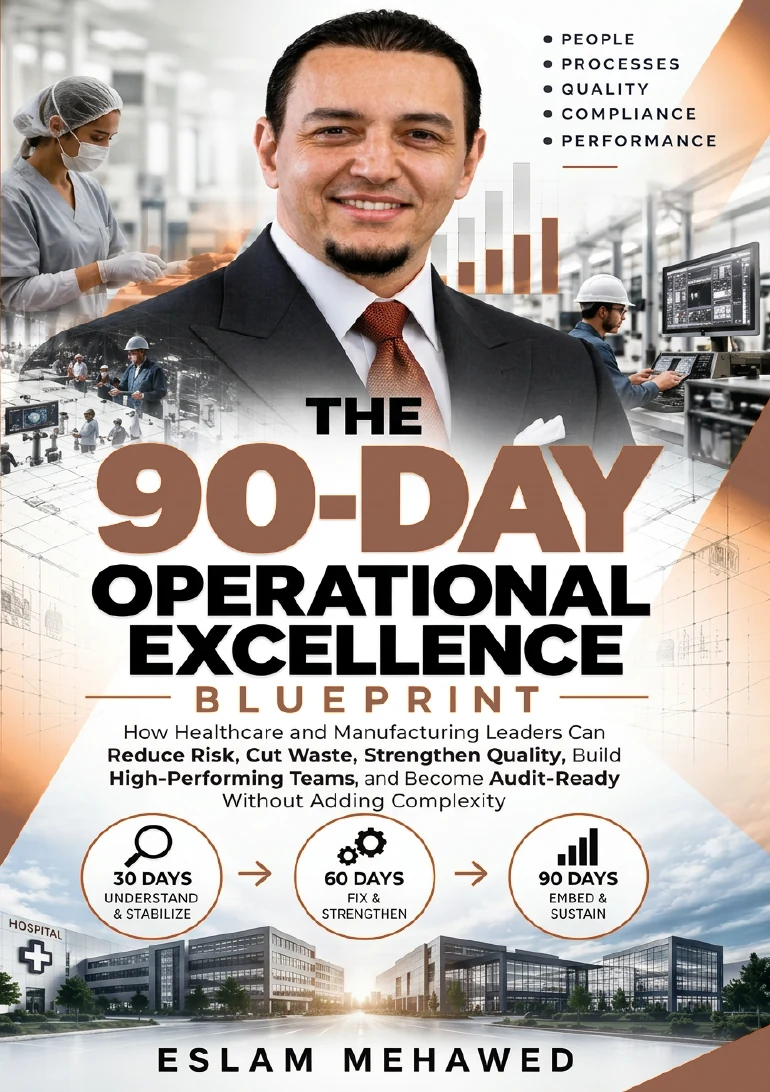
A PRACTICAL GUIDE BY ESLAM MEHAWED
Better questions. Clearer priorities. Practical progress.
A practical guide to identifying operational risks, prioritizing improvements, strengthening quality systems, developing teams, and building better audit readiness.
Download the Blueprint Ebook For FreeThe free e-book is available in English.
FROM THE BLOG
Use root cause tools to organize questions, then check the explanations against records and observations.
A PRACTICAL NEXT STEP
Discuss your quality, regulatory, or operational priorities and explore practical next steps.
Book a Discovery CallJeddah, Saudi Arabia · Arabic & English